Superpowers and Space Exploration: Balancing Scientific Research with Economic Interests
Technology
In our current era, the space race has become more diverse among nations. Competition between scientific research and economic problems has become paramount in this challenge.

The challenges and opportunities in this field require careful study. Investments in scientific research can lead to significant discoveries and the development of new technologies.
Key Takeaways
- Balancing scientific research and economic investments is crucial in the space race.
- Investments in scientific research can lead to significant discoveries.
- Challenges in this field require careful study.
- Major powers compete in the space race.
- Technological development is one of the main benefits of investing in scientific research.
Overview of the 21st Century Space Race
With the beginning of the 21st century, humanity entered a new phase of space competition. This renewed race is not limited to scientific goals only, but also includes economic and strategic motivations.
Historical Development of Space Exploration
Space exploration began in the second half of the 20th century, with the launch of the first artificial satellite, Sputnik, by the Soviet Union in 1957. This was followed by numerous achievements, including the landing of humans on the Moon during the American Apollo program in 1969.
Subsequent decades witnessed remarkable progress in space technology, with the launch of space stations and the development of reusable space shuttles. These advancements paved the way for further exploration and scientific research in space.
Reasons for the Renewed Space Race Among Major Powers
The renewal of the 21st-century space race is due to several main reasons:
Technological and Scientific Competition
Major countries compete to achieve technological achievements and scientific discoveries in space. This competition drives innovation and contributes to the advancement of science and technology.
Economic and Strategic Motivations
Space has become a field for economic competition, as countries seek to exploit space resources and develop space infrastructure. Additionally, space plays a strategic role in influencing a country's military and economic power.
In conclusion, the 21st-century space race involves multifaceted competition among major powers, driven by the desire to achieve technological and scientific excellence and to benefit from the economic and strategic opportunities offered by space.
Competition Between the U.S., Russia, and China in Global Space Programs
The global space arena witnesses intense competition between the U.S., Russia, and China within advanced space programs. This competition extends beyond technology to strategic and economic dimensions.
Modern U.S. Space Programs
American space programs are characterized by technological progress and innovation. The Artemis Program is one of the most prominent, aiming to return humans to the Moon and establish a permanent presence there. NASA is also developing new technologies for Mars exploration.
Russia’s Renewed Space Strategy
Russia is rebuilding its space strategy by updating space infrastructure and developing new technologies. The Russian space agency, Roscosmos, works to enhance international cooperation and achieve its strategic space objectives.
Rise of China as a Global Space Power
China has become a key player in the global space race. Chinese space programs are marked by rapid progress and continuous development.
Tiangong Space Station Project
The Tiangong Space Station is one of China's major projects, representing a significant step toward establishing a permanent Chinese presence in space.
Chinese Lunar and Mars Exploration Program
China is also working on programs for lunar and Mars exploration, aiming to achieve scientific discoveries and develop new technologies for deep space exploration.
These advanced space programs reflect the intense competition between the U.S., Russia, and China, as each country seeks to achieve its strategic objectives and strengthen its position as a leading space power.
Strategic and Political Dimensions of Outer Space Control
Outer space now represents a new domain for geopolitical influence, as major countries aim to enhance their position through advanced space programs.
Space as a Geopolitical Arena
Outer space has become an integral part of countries' geopolitical strategies, used as a tool to enhance power and influence. Countries with advanced space capabilities can achieve multiple strategic objectives, from communications and navigation to reconnaissance and exploration.
Impact of Space Programs on International Relations
Space programs significantly influence international relations, serving either as a tool for cooperation or competition. Collaboration in space projects can strengthen ties between countries, while competition may lead to tensions.
Militarization of Space: Risks and Challenges
The militarization of space presents a major challenge for the international community, potentially leading to a new arms race in space. This situation raises concerns about global security stability and requires international efforts to regulate space use.
In conclusion, the strategic and political dimensions of outer space control present a complex challenge requiring international cooperation and coordination to ensure the peaceful and sustainable use of space.
Major Powers and Space Exploration: Balancing Scientific Research and Economic Interests
In the modern space race, major powers strive to maintain a delicate balance between scientific goals and economic investments. This balance is not easy, as it requires effective allocation of resources between scientific research and economic benefits.
How Major Countries Balance Scientific and Economic Goals
Major countries employ multiple strategies to achieve a balance between scientific and economic goals in space projects. These strategies include investing in scientific research that may lead to economically valuable discoveries and developing new technologies applicable across multiple fields.
For example, NASA has invested heavily in asteroid research, leading to the development of new technologies that can be used in space exploration and resource utilization.
Case Studies of Successful Balance Between Research and Investment
There are several examples of successful balance between scientific research and economic investment in space projects. One example is the European Space Program, which successfully balanced scientific objectives and economic benefits through investments in Mars missions and asteroid exploration.
| Program | Scientific Goals | Economic Investments |
| European Space Program | Mars and asteroid exploration | Development of new technologies |
| NASA | Asteroid research | Development of space exploration technologies |
Challenges in Achieving Balance in Space Projects
Despite efforts, major countries face significant challenges in achieving a balance between scientific and economic goals. These challenges include the high cost of space projects, risks associated with investing in new technologies, and the need for international cooperation to ensure project success.
In conclusion, achieving a balance between scientific research and economic interests in space projects is a major challenge, but essential for ensuring success and maximizing benefits.
The Role of Scientific Research in Developing Space Projects
Scientific research plays a crucial role in developing space projects, contributing to major scientific discoveries. Through scientific exploration, we can improve our understanding of space and develop the necessary technologies for its exploration.
Key Scientific Discoveries in Space
Key scientific discoveries in space include the detection of exoplanets and understanding cosmic phenomena such as black holes and pulsars. These discoveries expand human knowledge and guide future research.
How Scientific Research Drives Innovation in the Space Sector
Scientific research drives innovation in the space sector by developing new technologies such as advanced rocket propulsion and space communications. These innovations not only enhance space exploration capabilities but also improve technology on Earth.
Scientific research also encourages international collaboration and knowledge sharing, enhancing technological progress in general.
Impact of Space Research on Overall Technological Advancement
Space research has a major impact on overall technological advancement, leading to the development of technologies such as artificial intelligence and solar energy. These technologies find applications not only in space but also in daily life.
Carl Sagan said: "Some places in the universe, like the Moon and Mars, may be open to human exploration in the near future."
Technical Challenges Facing Major Powers in Space Exploration
Space exploration is not easy, as major powers face many technical challenges. These challenges range from long-range space missions to advanced rocket propulsion technologies.
Challenges of Long-Range Space Missions
Long-range space missions pose a major challenge due to the need for large resources and advanced technology. For example, Mars missions take months, requiring careful planning and advanced technologies to handle environmental and logistical challenges.
Communication and Navigation Issues in Deep Space
Communication and navigation in deep space present a significant technical challenge. Signals take a long time to reach Earth, requiring the use of advanced communication technologies and precise navigation systems.
Innovation in Rocket Propulsion Technologies
Rocket propulsion technologies are a vital part of space exploration. Innovation in this field can reduce costs and increase mission efficiency.
Nuclear and Electric Propulsion Technologies
Nuclear and electric propulsion technologies are among the latest developments in rocket propulsion. These technologies offer higher efficiency and allow for longer space missions.
Future Rocket Engines
Future rocket engines will rely on advanced technologies such as nuclear thermal propulsion and ion propulsion. These technologies will make space missions more efficient and effective.
| Technology | Description | Advantages |
| Nuclear Propulsion | Using nuclear energy to propel rockets | Higher efficiency, longer missions |
| Electric Propulsion | Using electrical energy to accelerate ions | High efficiency, low fuel consumption |
Asteroid Exploration: New Economic Opportunities for Superpowers
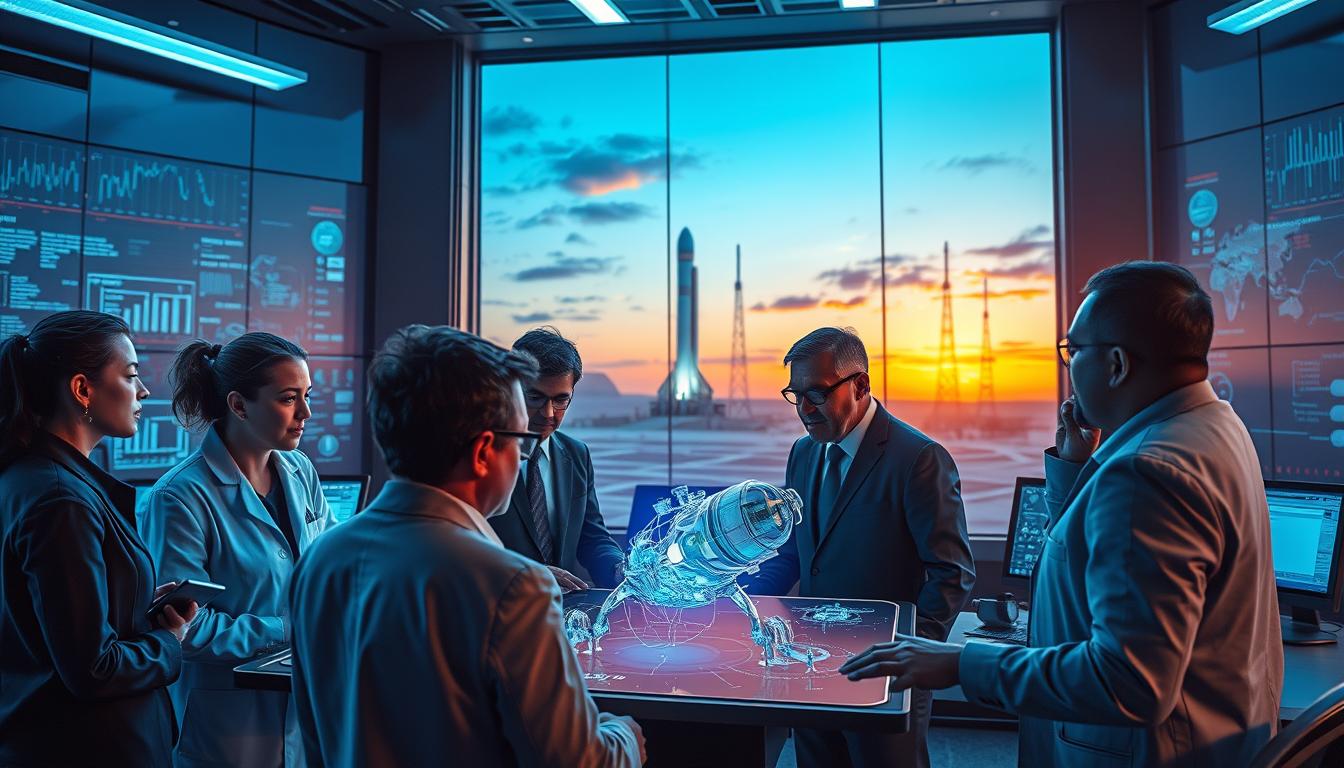
Asteroid exploration opens new horizons for superpowers to achieve economic gains by exploiting the vast mineral resources available in space. In this context, major countries are racing to explore and develop technologies for extracting minerals from asteroids.
Mineral Resources in Asteroids and Their Exploitation Potential
Asteroids contain enormous amounts of precious metals such as platinum and gold, in addition to other metals like iron and nickel. These resources present a significant economic opportunity that could shift the balance of global economic power.
Future Space Mining Technologies
Extracting minerals from asteroids requires the development of advanced technologies capable of handling space challenges such as low gravity and harsh environments. Leading companies in this field are developing specialized robots and spacecraft capable of performing mining operations in space.
Leading Companies in Asteroid Exploration
Private sector participation in asteroid exploration and the development of space mining technologies is increasing. Companies like Planetary Resources and Deep Space Industries lead this trend through ambitious projects aimed at making asteroid mining a reality.
By exploiting these opportunities, superpowers can enhance their economic standing and open new avenues for future economic growth.
How Major Countries Invest in Space Resources
Major countries compete to exploit space resources to gain a competitive advantage. Investing in space resources has become an integral part of strategies to strengthen economic and geopolitical capabilities.
Space Investment Strategies for Superpowers
Superpowers adopt different strategies to exploit space resources. These strategies include investing in space mining technologies, developing space infrastructure, and launching exploratory missions.
For example, the United States invests in programs to utilize space resources, such as the "Artemis" program, which aims to return humans to the Moon and establish a permanent presence there.
Expected Economic Returns from Space Resource Exploitation
Exploiting space resources is expected to generate significant economic returns. These returns include extracting precious metals from asteroids and using helium-3 to meet nuclear energy needs.
Space resource exploitation is also expected to create new industries and stimulate global economic growth.
Competition for Strategic Locations in Space
Competition is increasing among major countries for strategic locations in space, such as geostationary orbits and locations on the Moon’s surface.
These locations are highly strategic as they provide significant advantages in communications, remote sensing, and navigation.
Investment Opportunities in Satellites and Space Infrastructure
With technological advancements, satellites and space infrastructure have become attractive to investors worldwide. This sector offers promising investment opportunities in multiple fields.
Commercial Satellite Market
The commercial satellite market is experiencing rapid growth, driven by increasing demand for communications, navigation, and remote sensing services. Major companies compete to provide advanced solutions and meet growing customer needs.
| Company | Service Type | Target Region |
| SES | Satellite Communications | Global |
| Intelsat | Satellite Communications | Global |
| OneWeb | Satellite Internet | Global |
Space Tourism Projects
Space tourism represents a new and exciting investment opportunity. With advances in technology and the development of reusable spacecraft, it is now possible to offer unique space tourism experiences.
Commercial Space Stations and Future Colonies
Commercial space stations and future colonies are among the most prominent investment opportunities in space infrastructure. These projects provide new possibilities for scientific research and commercial utilization.
Space-Based Energy Projects: Innovations and Future Challenges
Space-based energy projects open new horizons for finding renewable and sustainable energy sources. Given the challenges facing traditional energy, exploring alternative energy sources has become crucial.
Space solar power stations are among the most notable innovations in this field. These stations use solar panels in space to convert solar energy into electricity.
Space Solar Power Stations
Space solar power stations collect solar energy in space, where sunlight is continuous and unaffected by weather conditions.
Energy Transmission Technologies from Space to Earth
Space-based energy projects require advanced technologies to transmit energy from space to Earth, including the use of electromagnetic waves or lasers.
These technologies are promising for achieving high efficiency in energy transfer with minimal losses.
Economic Feasibility of Space Energy Projects
Despite technical challenges, studies indicate that space energy projects can be economically viable in the long term.
The economic feasibility of these projects depends on reducing operational costs and increasing energy production efficiency.
Impact of International Cooperation on the Space Race Among Superpowers
The impact of international cooperation on the space race among superpowers is an important topic in the context of space exploration. In recent years, there has been an increase in cooperation among countries in space projects, leading to significant achievements in this field.
Models of International Cooperation in Space Projects
There are several models of international cooperation in space projects, including:
- Joint programs among different space agencies.
- Research projects involving multiple countries.
- Partnerships between the public and private sectors.
International Space Station as a Model for Cooperation
The International Space Station is a successful model of international cooperation in space. It involves multiple countries, including the United States, Russia, Japan, Canada, and Europe. The station symbolizes peaceful collaboration in space and provides a platform for scientific research and technological development.
Future of International Cooperation in Deep Space Exploration
With technological advancement and growing interest in deep space exploration, international cooperation is expected to play a greater role in the future. Exploring distant planets and maintaining a human presence in space will require close collaboration among nations.
| Project | Participating Countries | Objective |
| International Space Station | United States, Russia, Japan, Canada, Europe | Scientific research and technological development |
| Artemis Program | United States and Europe | Returning humans to the Moon |
In conclusion, the impact of international cooperation on the space race among superpowers is evident in many successful projects. By continuing to enhance this cooperation, we can achieve further accomplishments in space exploration.
Role of the Private Sector in Funding Space Programs
In the context of recent developments in space, private companies play an increasingly important role in funding space programs. This role is not limited to providing financing but also includes innovation and the development of new technologies.
Rise of Private Space Companies
Over the past decade, many private space companies have emerged, transforming the space industry. Companies such as SpaceX and Blue Origin have been at the forefront of these developments, introducing revolutionary innovations in reusable rocket technology.

Models of Public-Private Partnership in Space Projects
There are various models of partnership between the public and private sectors in space projects. One such model is the collaboration between government space agencies and private space companies. For example, NASA has collaborated with SpaceX on many projects, including missions to the International Space Station.
| Company | Project | Type of Partnership |
| SpaceX | Missions to the International Space Station | Service Contract |
| Blue Origin | Development of reusable spacecraft | Private Investment |
Potential Threats to Space Investment
Despite promising opportunities, space investments face significant challenges. Technical and financial challenges are among the main obstacles that investors in this sector may encounter.
Legal Frameworks for Regulating Outer Space Use and Exploitation
With the advancement of space exploration, it has become necessary to establish laws regulating the use and exploitation of outer space. This requires treaties and international agreements to ensure responsible and sustainable use of space.
International Treaties Regulating Space
Several international treaties play a key role in regulating outer space use. These include the 1967 Outer Space Treaty, which prohibits the use of nuclear weapons in space and emphasizes the principle of freedom of exploration and peaceful use of space.
Legal Challenges of Exploiting Space Resources
Exploiting space resources faces significant legal challenges. One such challenge is the interpretation of the concept of "peaceful use" of space, as countries differ in their interpretation. Additionally, there are challenges related to ownership of space resources and how to share them among nations.
Need for New Legislation in the Era of Space Commerce
With the growth of the space industry and increasing commercial activities in space, there is an urgent need to enact new legislation to regulate these activities. This includes laws related to space ownership, liability for damages caused by space activities, and regulations for space mining operations.
Conclusion
In the midst of the renewed space race among superpowers, the question arises of how to balance scientific research and economic investments. Superpowers see space exploration not merely as exploration but as a comprehensive strategy encompassing scientific and economic objectives.
Balancing scientific research with economic investments in space represents a major challenge. Major countries seek to achieve scientific goals through research and discoveries while simultaneously investing in projects that provide economic returns.
The future of space exploration depends on countries' ability to maintain this balance. Through international cooperation and leveraging advanced technologies, significant progress can be made in space exploration.
Ultimately, the conclusion is that the future of space depends on a delicate balance between scientific and economic goals, which will determine the trajectory of the space race in the coming years.
FAQ
What are the main reasons for the revival of the space race among superpowers in the 21st century?
The main reasons for the revival of the space race are technological and scientific competition, along with economic and strategic motivations, as superpowers aim to strengthen their geopolitical standing and achieve technological advancement.
How do major countries balance scientific and economic objectives in space projects?
Major countries balance scientific and economic objectives by investing in space projects that serve both purposes, such as asteroid exploration and the development of rocket propulsion technologies.
What are the main technical challenges facing superpowers in space exploration?
The main technical challenges include long-duration space missions, communication and navigation issues in deep space, and the development of advanced rocket propulsion technologies.
How can international cooperation affect the space race among superpowers?
International cooperation can enhance space exploration progress through resource and expertise sharing, cost reduction, and improved safety in space.
What is the role of the private sector in funding space programs?
The private sector plays a significant role in funding space programs through investment in commercial space projects, developing new technologies, and partnering with governments.
What are the current legal frameworks for regulating the use and exploitation of outer space?
Current legal frameworks include international treaties such as the Outer Space Treaty, which regulate space use and define nations’ rights in space exploration.
How can major countries benefit from asteroid exploration?
Major countries can benefit from asteroid exploration by extracting mineral resources, developing space mining technologies, and increasing scientific knowledge.
What are the investment opportunities in satellites and space infrastructure?
Investment opportunities include the commercial satellite market, space tourism projects, and commercial space stations and future colonies.
How can space-based energy projects contribute to meeting global energy needs?
Space-based energy projects, such as space solar power stations, can help meet global energy needs by providing a clean and sustainable energy source.