The Future of Work with Artificial Intelligence in 2026 (Complete Guide to New Jobs, In-Demand Skills, and How AI Will Transform the Global Job Market)
Technology
Discover the future of work with artificial intelligence in 2026, including new job roles, in-demand skills, and how AI is reshaping the global workforce and career opportunities.
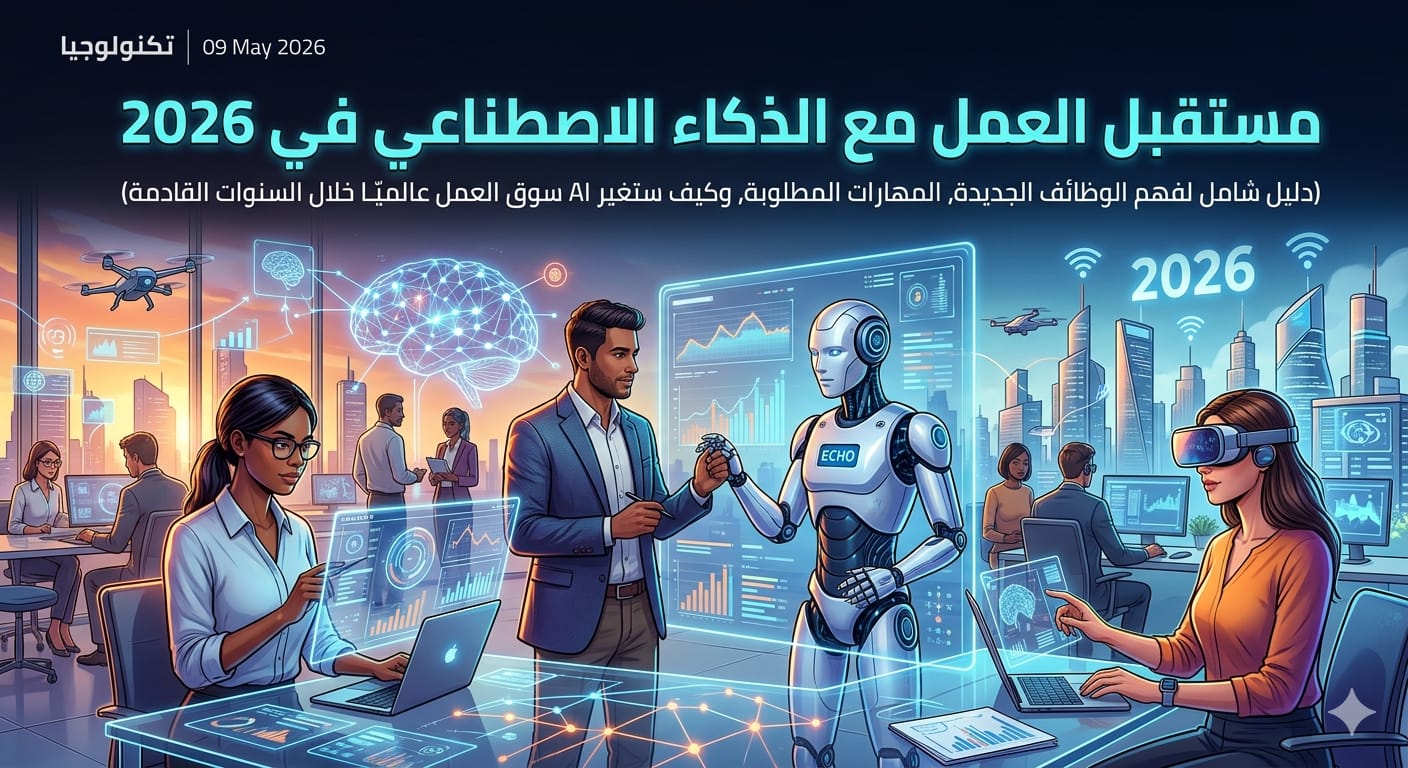
The Future of Work with Artificial Intelligence in 2026 (Comprehensive Analysis of Jobs, Skills, and Global Workforce Transformation)
The future of work with artificial intelligence in 2026 is centered on the integration of humans with intelligent systems, where digital skills, data literacy, and AI collaboration become more important than traditional job roles, transforming the global labor market into an automated, data-driven, and decision-enhanced environment.
Introduction: Why AI is Rebuilding the Concept of Work
The world is not just evolving—it is being rebuilt by artificial intelligence.
In 2026, the question is no longer “Will AI affect jobs?”
Instead, it is “Which jobs will disappear, which will evolve, and what new roles will emerge?”
Artificial intelligence is no longer just a tool.
It is now an active participant in work processes—analyzing data, generating content, coding software, designing systems, and even assisting in business decisions.
This transformation creates massive opportunities for some while disrupting traditional career paths for others.
In this guide, you will understand:
- How the global job market is changing
- Which jobs are disappearing and why
- Which new jobs are emerging
- How to prepare for the AI-driven future
PART 1 — The Global Workforce Transformation
How Artificial Intelligence Is Redefining Traditional Jobs
Traditional jobs were based on repetitive manual or cognitive tasks performed in fixed routines.
Artificial intelligence has disrupted this model by automating large portions of daily work.
Today, employees are no longer just task executors—they are AI supervisors, data interpreters, and decision enhancers.
Performance is now measured by AI-assisted productivity rather than time spent working.
This shift is redefining what a “job” actually means in the modern economy.
Key Changes in the Workforce
- Reduction of repetitive tasks
- Increased automation across industries
- Heavy reliance on data-driven decisions
- Shift toward creativity and analytical thinking
Analysis of the U.S. Job Market (AI-Driven Employment Trends)
In the United States, major companies such as Google, Microsoft, and Amazon are integrating AI into nearly every operational layer.
This has reduced demand for traditional roles while increasing demand for data science, machine learning, and AI engineering positions.
Companies now prefer employees who can work alongside AI systems rather than compete with them.
Data entry and repetitive administrative roles are declining rapidly.
Meanwhile, technical and creative roles are seeing higher salaries and stronger demand.
Market Trends
- Growth in AI-related jobs
- Decline in routine manual jobs
- Higher salaries for digital skills
- Expansion of hybrid work models
Jobs That Will Disappear Due to AI
Artificial intelligence does not eliminate jobs directly—it automates tasks within those jobs.
Roles based on repetition and predictable processes are the most vulnerable.
Examples include data entry, basic customer support, and routine accounting tasks.
However, this does not mean the end of employment—it means job restructuring.
Humans are shifting from execution to supervision and analysis.
Examples of Affected Jobs
- Data entry clerks
- Traditional customer service agents
- Basic accounting roles
- Administrative routine jobs
Why Companies Are Rapidly Adopting AI
Companies are not adopting AI because it is trendy, but because it significantly reduces costs and increases productivity.
AI systems operate 24/7 without fatigue and process massive datasets in seconds.
They also improve decision-making accuracy and speed.
As a result, AI has moved from an optional tool to a core business necessity.
Companies that fail to adopt AI risk falling behind competitors.
Core Drivers
- Cost reduction
- Productivity growth
- Faster decision-making
- Operational efficiency
PART 2 — New Jobs in the AI Era
Most In-Demand Future Jobs in 2026
In the near future, jobs will not disappear but will evolve into more specialized roles.
New careers will focus on managing intelligent systems and interpreting AI outputs.
Roles such as AI engineers, data analysts, and automation designers are rapidly growing.
Hybrid roles combining creativity and technology are also emerging.
This creates a massive wave of new career opportunities globally.
Top Emerging Jobs
- AI Specialist
- Data Analyst
- Machine Learning Engineer
- Automation Designer
Impact of AI on Creative Professions
Creative jobs such as design, writing, and media production are not disappearing—they are evolving.
AI tools are now used to generate ideas, speed up production, and improve quality.
Designers use AI for inspiration and optimization.
Writers use AI to enhance productivity and research.
However, human creativity remains the core differentiator.
Key Impacts
- Increased productivity
- Higher content quality
- Faster creative workflows
- AI-assisted creativity
Traditional Workers vs AI-Enhanced Workers
Traditional workers rely on manual experience and repetitive execution.
AI-enhanced workers use digital tools to analyze, automate, and optimize tasks.
This makes them significantly more productive and efficient.
Companies increasingly prefer workers who can operate AI tools effectively.
This gap will continue to widen in the coming years.
Quick Comparison
- Traditional = Execution
- AI-Enhanced = Analysis + Automation
- Productivity = Higher with AI
- Demand = Higher for digital skills
Skills Required in the New Job Market
Job requirements are no longer limited to academic qualifications.
Digital literacy, analytical thinking, and AI tool proficiency are now essential.
The ability to learn quickly is more valuable than long-term experience.
Adaptability has become a core professional skill.
The modern job market rewards continuous learners.
Key Skills
- Data analysis
- AI tool usage
- Critical thinking
- Continuous learning
PART 3 — Preparing for the AI-Driven Career Future
How to Build a Career in the Age of Artificial Intelligence
Starting a career in the AI era does not require advanced degrees.
It begins with understanding industry trends and learning foundational AI tools.
Next, choose a field such as marketing, programming, or data analysis.
Apply knowledge through real-world projects.
Execution matters more than theory.
Starting Steps
- Learn AI fundamentals
- Choose a specialization
- Practice real projects
- Build a portfolio
Common Mistakes That Prevent Career Growth
The biggest mistake is ignoring artificial intelligence completely.
Another mistake is failing to upgrade skills regularly.
Some assume AI will replace them entirely, leading to stagnation.
In reality, professionals who use AI outperform those who do not.
Resistance to change is the biggest career risk.
Common Mistakes
- Ignoring AI technology
- Lack of continuous learning
- Resistance to change
- Dependence on outdated skills
The Future of Jobs in the Coming Years
The future will not eliminate jobs—it will transform them.
Roles will become more technical and data-driven.
Humans and AI systems will work together across all industries.
Organizations will become fully intelligent and automated.
Success will depend on adaptability and continuous learning.
Future Trends
- Digital-first jobs
- AI-integrated workflows
- Full automation systems
- Knowledge-based economy
❓ FAQ (People Also Ask)?
How will AI affect jobs?
AI will automate repetitive tasks and create new technical roles.
Will AI replace all jobs?
No, it will transform jobs rather than eliminate them.
What are the best future careers?
AI engineering and data analysis roles are in high demand.
How can I prepare for the future job market?
By learning digital skills and AI tools.
Conclusion
The future of work is no longer stable—it is constantly evolving.
Artificial intelligence is not eliminating jobs; it is reshaping them.
The real winners are those who learn, adapt, and evolve quickly.
Start developing your skills today—because the future waits for no one.