How to Protect Your Personal Data from Hacking and Cyber Fraud in 2026? The Strongest Cybersecurity Strategies to Protect Your Accounts and Money from Hackers
Technology
How to Protect Your Personal Data from Hacking and Cyber Fraud in 2026? Complete Cybersecurity Guide
Discover the best ways to protect your personal data from hacking and cyber fraud in 2026 using advanced cybersecurity strategies, strong passwords, two-factor authentication, and secure online banking protection.
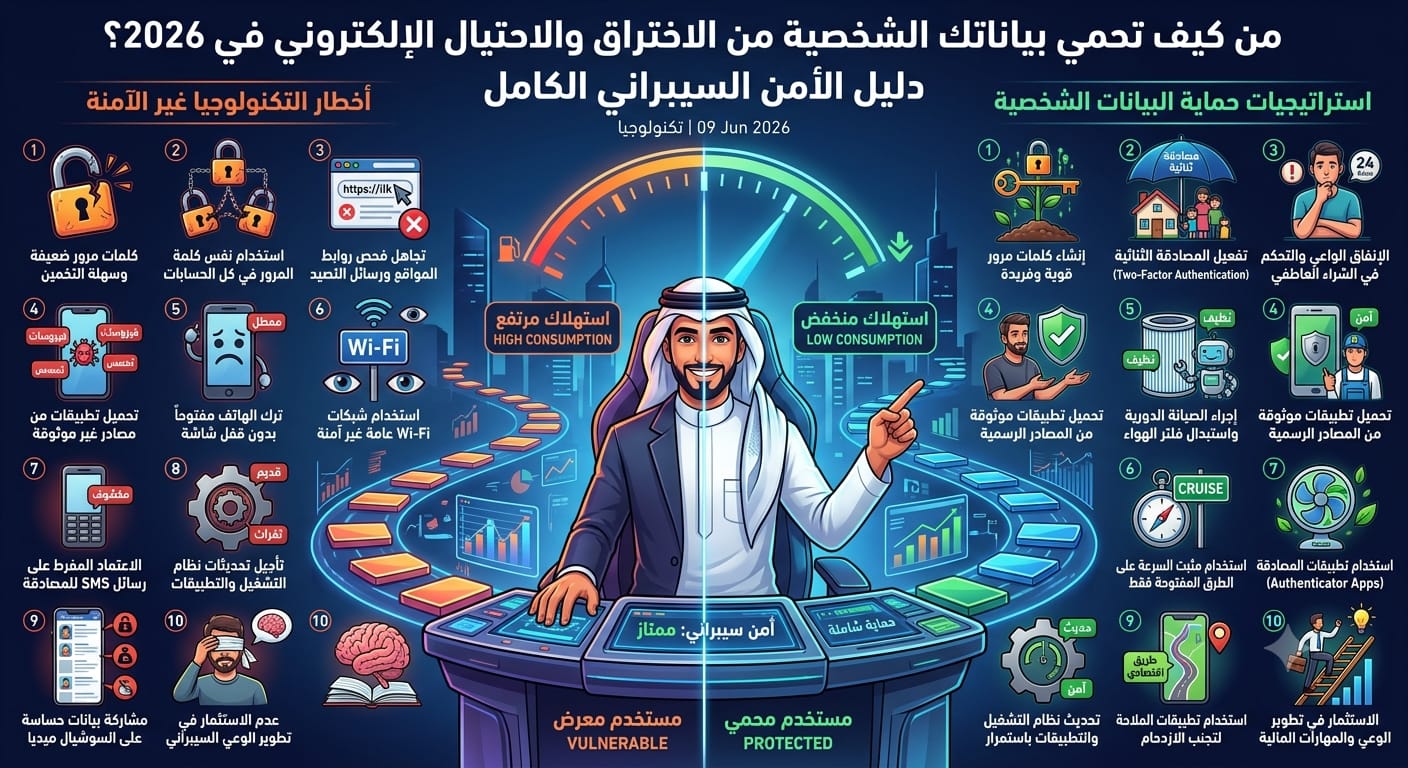
How to Protect Your Personal Data from Hacking and Cyber Fraud in 2026?
Introduction
In 2026, personal data has become more valuable than money itself. The information users share online every day — including email accounts, banking details, photos, passwords, and even location data — has become a direct target for hackers and cybercriminal networks. Over the past few years, cyberattacks have increased dramatically across the United States and Europe, while hacking techniques have become more sophisticated through artificial intelligence and advanced phishing technologies. Cybersecurity is no longer optional; it has become an essential necessity for anyone using the internet, smartphones, or digital banking services.
Many people believe cyberattacks only target large corporations, but the reality is that ordinary users have become the easiest and most vulnerable targets. Cybercriminals rely on simple mistakes such as weak passwords, fake links, or unsafe applications to gain access to personal data, steal money, and compromise accounts. Even worse, many victims only discover the breach after losing access to bank accounts, suffering financial fraud, or having private information leaked online.
This article is not just another collection of repetitive cybersecurity tips. It is a professional and comprehensive guide based on the latest cybersecurity trends in the American and European markets. You will learn about the most dangerous cyber fraud techniques in 2026 and how to protect your personal information, banking accounts, and smartphone from hackers using the latest digital security strategies.
Why Has Personal Data Become a Primary Target for Hackers in 2026?
Personal data is no longer just ordinary information. It has become a digital asset that can be sold, exploited, and monetized in dangerous ways. Advertising companies, cybercriminals, financial fraud networks, and illegal organizations are constantly seeking user data because it generates billions of dollars annually. Every piece of information shared online can potentially be used for targeted advertising, cyber fraud, identity theft, or social engineering attacks.
Artificial intelligence has dramatically transformed cybercrime over the past few years. Hackers now use advanced AI tools to create highly realistic phishing emails and even clone voices using deepfake technologies to deceive victims. As a result, cyber fraud has become significantly more difficult to detect compared to previous years.
At the same time, the rapid growth of digital banking, cloud storage, and remote work has increased the amount of sensitive information stored online. Every new account, app, or online service creates another potential vulnerability if not properly secured. This is why cybersecurity has become one of the fastest-growing and most profitable industries in the United States and Europe.
The Most Dangerous Cyber Fraud Methods Threatening Users in 2026
Cyber fraud operations have become more sophisticated and professional than ever before. Hackers no longer rely solely on traditional malware or viruses; they now use social engineering and psychological manipulation to deceive victims. Most successful cyberattacks actually begin with a simple human mistake rather than advanced technical hacking.
One of the most dangerous threats today is phishing attacks. These attacks often arrive through email or social media messages disguised as legitimate communication from banks, well-known companies, or trusted services. Their goal is to steal passwords, banking information, or personal credentials using fake login pages.
Additionally, fake applications that imitate legitimate banking apps or social media platforms have become increasingly common. Many users unknowingly install these malicious apps from unofficial sources, allowing hackers to steal sensitive information directly from smartphones.
How Modern AI-Powered Phishing Works
Phishing attacks in 2026 have become far more intelligent due to artificial intelligence technologies that analyze user behavior and generate personalized messages that appear completely authentic. Some phishing emails even contain real personal details obtained from previous data leaks, increasing the likelihood that victims will trust them.
Hackers also use AI tools to replicate the design and appearance of legitimate websites with incredible accuracy. Users may believe they are logging into their real online banking accounts while unknowingly sending their credentials directly to cybercriminals. For this reason, users should always verify website URLs carefully before entering sensitive information.
How to Create Strong Passwords That Prevent Account Hacking
Weak passwords remain the leading cause of personal account breaches worldwide. Many users still rely on easy passwords such as birthdays, repetitive numbers, or simple names that can be guessed within seconds using modern password-cracking software. A strong password should be long, complex, and include uppercase letters, lowercase letters, numbers, and special symbols.
Another major problem is password reuse. Many people use the same password across multiple accounts. If one account is compromised, hackers can easily access other services using the same credentials. Every important account should have a unique password.
Why Password Managers Are Essential
Password managers have become one of the most important cybersecurity tools because they help users generate and securely store complex passwords. These tools use advanced encryption technologies to secure stored information, making unauthorized access nearly impossible without the master password. Some password managers also provide alerts when passwords appear in data breaches.
The Importance of Two-Factor Authentication for Protecting Personal and Banking Accounts
Two-factor authentication has become one of the strongest defenses against modern cyberattacks. Even if hackers manage to steal a password, they still need a second verification step such as a temporary code sent to a phone or generated through an authentication app. This technology has significantly reduced account breaches involving banking services and email platforms.
What Is the Difference Between Authentication Apps and SMS Verification?
Although SMS verification is better than having no additional security layer, authentication apps such as Google Authenticator and Microsoft Authenticator are far more secure because they do not rely on mobile phone networks. Some cybercriminals use SIM-swapping attacks to hijack phone numbers and intercept SMS codes. Authentication apps also work offline and generate constantly changing verification codes.
How to Protect Your Smartphone from Hacking and Spyware
Modern smartphones contain nearly every aspect of daily life. One of the most important security practices is keeping the operating system and applications fully updated. Security updates not only add new features but also patch vulnerabilities that attackers may exploit. Users should also avoid downloading applications from unofficial sources and review app permissions carefully.
How to Detect If Your Smartphone Has Been Hacked
Several warning signs may indicate spyware or hacking activity on a smartphone, including unusual overheating, rapid battery drainage, excessive mobile data usage, random pop-up advertisements, or unexplained performance slowdowns. In these situations, users should immediately scan the device using trusted antivirus software and change important passwords.
The Best Ways to Protect Online Banking and Digital Payments
Online banking and e-commerce services are among the most targeted industries. One of the most important rules is avoiding public Wi-Fi networks when accessing banking accounts. Users should also verify that websites use HTTPS encryption and display a secure lock icon before entering payment details.
Why Virtual Credit Cards Are More Secure
Virtual payment cards have become one of the safest solutions for online shopping because they generate temporary card numbers for limited-time usage. Even if an online store suffers a data breach, cybercriminals cannot access the real banking card. Using virtual cards significantly reduces the risk of online financial fraud.
The Future of Cybersecurity and Personal Data Protection in 2026
The digital world is evolving rapidly, and cyber threats continue advancing at the same pace. Biometric authentication technologies such as facial recognition and voice identification are expected to become far more common. Additionally, Zero Trust Security models are gaining widespread adoption, assuming that every device may already be compromised until verified.
Conclusion
Protecting personal data is no longer optional in the era of artificial intelligence and advanced cybercrime. Hackers and fraud networks depend on simple user mistakes to gain access to accounts, money, and sensitive information. Digital awareness has become the first line of defense against modern cyber threats. Simple actions such as using strong passwords, enabling two-factor authentication, and updating devices regularly can dramatically reduce the risk of hacking.
FAQ – Frequently Asked Questions?
What is the best way to protect online accounts from hackers?
Using strong and unique passwords combined with two-factor authentication is one of the most effective ways to secure online accounts.
Are public Wi-Fi networks dangerous?
Yes. Public Wi-Fi networks may allow hackers to monitor data and steal sensitive information if connections are not properly encrypted.
Are antivirus programs still necessary in 2026?
Yes. Modern malware, spyware, and cyber threats continue evolving rapidly, making antivirus protection highly important for smartphones and computers.
How can I know if my email account was hacked?
Signs may include unusual messages, unauthorized account changes, or login attempts from unknown devices and locations.
Is two-factor authentication alone enough for complete protection?
It is a very strong security layer, but it should be combined with strong passwords, software updates, and safe browsing habits.
Target
The best way to protect your personal data from hacking is to use strong and unique passwords, enable two-factor authentication, avoid suspicious links, update devices and apps regularly, and never use public Wi-Fi networks for sensitive accounts.