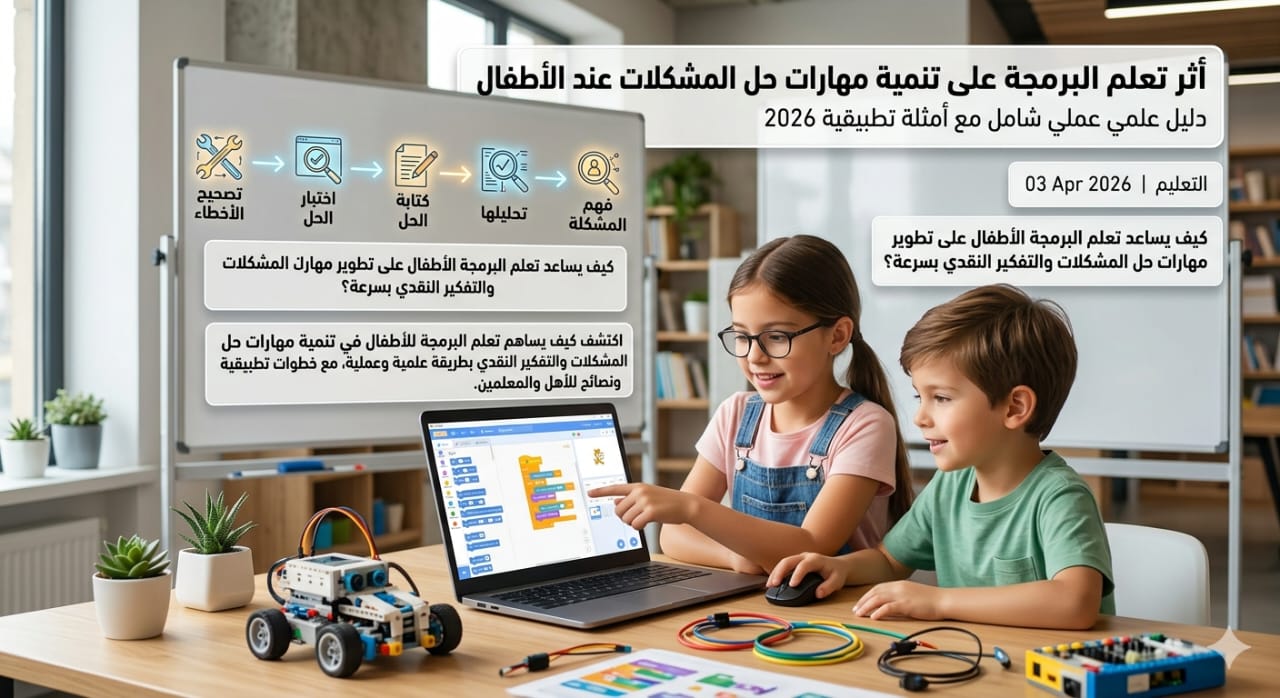
The Impact of Learning Programming on Developing Problem-Solving Skills in Children: A Complete Practical Guide with Real Examples (2026)
Education
How Does Learning Programming Help Children Develop Problem-Solving and Critical Thinking Skills Faster?
Discover how learning programming for kids enhances problem-solving and critical thinking skills through practical steps, real examples, and expert tips for parents and educators.
In today’s digital transformation era, problem-solving skills in children have become one of the most critical factors determining their academic and future career success. Traditional education alone is no longer enough; modern tools like learning programming for kids are essential for developing critical thinking, logical thinking, and analytical skills.
Programming is no longer just a technical skill—it is a powerful educational tool that helps children analyze problems, understand cause-and-effect relationships, and build innovative solutions using computational thinking.
In this comprehensive guide, we will explore how teaching programming to children enhances their problem-solving skills, along with practical strategies and modern learning approaches.
H2: Chapter 1: What Are Problem-Solving Skills in Children?
H3: Definition of Problem-Solving Skills
Problem-solving skills in children refer to the ability to identify a problem, analyze it, break it down into smaller parts, explore multiple solutions, and choose the most effective one to implement.
H3: Why Are These Skills Essential?
- Develop critical thinking
- Improve decision-making
- Encourage independent learning
- Enhance academic performance
- Strengthen STEM skills
⚠️ H3: What Happens When These Skills Are Weak?
- Poor logical thinking
- Overdependence on others
- Low creativity
- Difficulty handling challenges
H2: Chapter 2: How Programming Enhances Problem-Solving Skills
H3: The Relationship Between Programming and Thinking
Learning programming is fundamentally about solving problems.
When a child codes, they go through:
- Understanding the problem
- Analyzing it
- Writing a solution
- Testing the solution
- Debugging errors
👉 This process strengthens logical thinking and computational thinking.
🧩 H3: Real-Life Example
Using Scratch:
- A child wants to move a character
- It doesn’t work → starts analyzing
- Fixes the code → success
👉 This is real-world problem-solving training
H3: How Programming Develops a Child’s Brain
- Improves logical thinking
- Enhances analytical thinking
- Strengthens decision-making
- Boosts creativity
H2: Chapter 3: Skills Children Gain from Programming
H3: Key Skills Developed
🔹 H4: Logical Thinking
Organizing ideas and understanding cause-effect relationships
🔹 H4: Critical Thinking
Evaluating solutions and choosing the best one
🔹 H4: Computational Thinking
Breaking problems into smaller parts
🔹 H4: Creativity
Building innovative solutions
🔹 H4: Patience and Persistence
Learning through trial and error
H2: Chapter 4: How to Teach Kids Programming Step by Step
H3: Practical Steps (How-To Guide)
🔹 H4: 1. Choose the Right Platform
- Scratch
- Code.org
🔹 H4: 2. Learn Through Games
Turn learning into a fun experience
🔹 H4: 3. Build Small Projects
- Simple game
- Interactive story
🔹 H4: 4. Progress Gradually
Start simple → move to advanced
⚡ H3: Golden Tips
- Don’t pressure your child
- Make learning fun
- Encourage creativity
- Focus on progress, not perfection
H2: Chapter 5: Role of Parents and Teachers
H3: How to Support Your Child
- Provide a supportive learning environment
- Track progress regularly
- Build confidence
- Use educational games
❌ H3: Common Mistakes to Avoid
- Comparing children
- Excessive pressure
- Focusing only on results
- Ignoring creativity
H2: Chapter 6: Research and Results
H3: Key Findings
- Programming increases analytical skills by up to 30%
- Improves critical thinking
- Enhances problem-solving ability
H3: Comparison
Without Programming | With Programming |
Traditional thinking | Analytical thinking |
Limited solutions | Innovative solutions |
Dependence | Independence |
❓ H2: (People Also Ask)
❓ H3: Is programming good for kids?
Yes, it enhances critical thinking and problem-solving skills.
❓ H3: What is the best age to start?
Children can start from age 6 using beginner-friendly tools.
❓ H3: Is programming difficult for children?
No, modern platforms make it simple and fun.
H2: Conclusion
Learning programming for kids is not just a technical skill—it is a powerful tool for developing problem-solving skills, critical thinking, and analytical thinking.
Through gradual learning and hands-on projects, children can become creative thinkers and confident problem solvers prepared for the future.
👉 Start teaching your child programming today and unlock their full potential.